
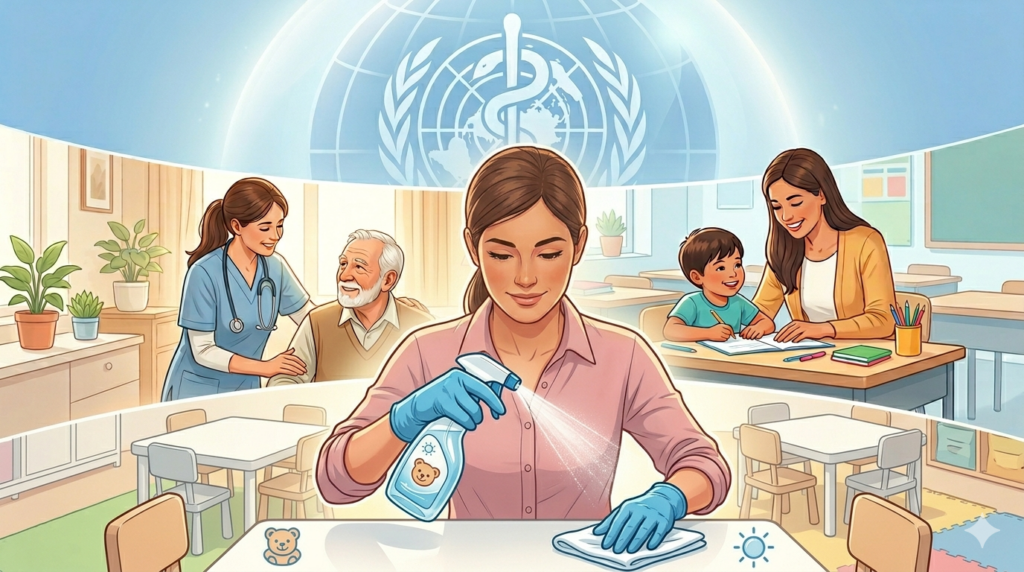
With the World Health Organization (WHO) declaring a new Public Health Emergency of International Concern (PHEIC), it is natural to look at the headlines and wonder what it means for our daily routines. In Hong Kong, whether we are managing a household, running a school, or operating caregiver environments like elderly homes and childcare centers, staying informed is simply part of how we look out for one another.
The latest declaration responds to an expansion of the Bundibugyo strain of Ebola in East and Central Africa. While local bodies like Hong Kong’s Centre for Health Protection (CHP) are taking proactive measures at our borders, they emphasize that the immediate risk to our local community remains very low.
Understanding the medical realities and transmission characteristics of this non-typical virus can bring peace of mind, helping us focus on practical, calm, and highly precise steps for keeping our shared spaces safe.
Confronting the Medical Reality: Why Prevention Comes First
International public health experts and organizations like Doctors Without Borders (MSF) have highlighted a major challenge in managing this outbreak: there are currently no approved vaccines or targeted antiviral cures anywhere in the world for the Bundibugyo strain. The highly effective vaccines that the public commonly associates with halting recent Ebola epidemics are strictly engineered for the Zaire strain and do not offer cross-protection against this virus.
In the absence of vaccines or specific cures, even a moderate clinical mortality rate poses a serious risk to highly specific, vulnerable environments. For young children with developing immune systems, or elderly residents in care homes who live with chronic health conditions, the introduction of such a high-risk pathogen into a shared facility would create an immense, unmanageable burden of care.
This means that with medical intervention (vaccines and targeted treatments) currently unavailable, Environmental Infection Prevention and Control (IPC) becomes our single most critical shield.
Understanding Transmission in Care and Group Environments
Fortunately, this virus is entirely non-airborne. It does not spread through the air, respiratory droplets, or casual everyday contact. Instead, its transmission relies strictly on direct contact with contaminated bodily fluids or physical surfaces that have been soiled by those fluids.
Because of this specific physical pathway, the thoroughness of environmental surface hygiene directly determines the safety of high-traffic or high-contact settings:
-
Elderly Homes & Caregiver Services: Residential care environments involve frequent physical assistance, bathing, and personal care routines. This means shared handrails, hoists, medical beds, and dining tables naturally become high-frequency touchpoints requiring robust defense.
-
Schools & Childcare Centers: Children naturally explore through physical touch and continuously share toys, desks, and play equipment, requiring highly efficient and reliable virus elimination mechanisms.
-
The Family Home: The ultimate sanctuary where all members return at the end of the day, making it the final line of defense against everyday germs brought in from the outside world.

Cleanliness Guidelines from Global Health Bodies: The Role of NaDCC
When international health organizations look at managing surface contamination for resilient viruses when vaccines are unavailable, they bypass temporary or cosmetic cleaning routines. They recommend compounds that thoroughly neutralize pathogens at a molecular level while remaining stable, predictable, and manageable for staff and families alike.
This is exactly why the World Health Organization (WHO) explicitly references and recommends NaDCC (Sodium Dichloroisocyanurate) in its global infection control and outbreak management guidelines.
In both public and domestic care settings, NaDCC provides irreplaceable protective value:
-
Releasing Hypochlorous Acid (HOCl): When a NaDCC tablet dissolves in regular water, it releases Hypochlorous Acid. This highly effective biocidal agent mirrors the human body’s natural defense system to eliminate 99.99% of bacteria, fungi, and both enveloped and non-enveloped viral structures.
-
Gentle Yet Powerful for Caregivers: Despite its medical-grade efficacy, the dissolved solution maintains a neutral, skin-friendly pH. It creates significantly less odor and irritation than traditional bleach, making it safe to use around classrooms, childcare centers, and elderly facilities without causing respiratory discomfort to sensitive groups.
-
High Stability in the Face of Uncertainty: Unlike traditional liquid bleach, which starts degrading and losing its potency within months of opening, NaDCC effervescent tablets stay perfectly stable in dry form for years. Care facilities and families can store a compact supply of tablets and instantly mix a fresh, full-strength solution exactly when needed—whether it’s a mild daily wipe-down for school desks or a high-level disinfection for a spill.
When medical vaccines and cures are still on the road to development, the most profound action we can take for our loved ones and caregiver colleagues is to align our environments with trusted international standards. By doing so, we turn everyday hygiene into an active act of care, creating a consistently clean, reassuring sanctuary for the people who matter most.
To explore our range of stable, easy-to-use NaDCC effervescent tablets and kits designed for complete peace of mind in homes, schools, and care facilities, visit the NaDCC Store.